

PTSD Therapy in Palm Beach Gardens, FL · Virtual Florida & Connecticut
A Body-Centered Path to PTSD Healing
PTSD therapy



You're functioning. Maybe even functioning well, by most measures. You go to work. You handle what needs handling. From the outside, you look fine.
But something happened. And life has felt different since.
Maybe you know exactly what it is. Maybe you've never said it out loud to another person. Maybe you've been carrying it so long it just feels like who you are now — the hypervigilance, the way certain sounds or smells take you somewhere you don't want to go, the exhaustion that has nothing to do with how much you slept. The part of you that never fully lands back in the present.
You are not broken. Your nervous system did exactly what it was built to do. It protected you. And it never got the signal that it was safe to stop.
That signal is what we work on together.
Hi! I'm Jennifer Goggin, LPC, LMHC, SEP. You can call me Jen. I'm a licensed psychotherapist and Somatic Experiencing Practitioner in Palm Beach Gardens, Florida. For the past twenty years, I've worked with people carrying trauma that runs deep — first responders, nurses and physicians, veterans, 9/11 survivors, survivors of religious and institutional abuse, and people whose trauma has no name they've ever felt comfortable using. In-person in Palm Beach Gardens and telehealth throughout Florida and Connecticut.
PTSD is treatable. I've seen this, across two decades and across every kind of story a person can carry.
"You don't have to retell it in detail. You don't have to perform your pain for me to understand what you're carrying. The body already knows. That's where we start."
Understanding the Condition
What Is PTSD and Who Does It Affect?
Post-traumatic stress disorder develops when something overwhelming happens and the nervous system cannot fully process and integrate it. Not because you're weak. Not because you didn't handle it right. Because what happened exceeded what any nervous system could absorb without help.
PTSD is not a character flaw. It is not a sign that you're not tough enough, not resilient enough, not professional enough to handle what the job required. It is a neurobiological response to genuine threat. It can happen to anyone. It happens to a lot of people who would never describe themselves as someone who gets traumatized.
It develops after:
Combat exposure — Vietnam, the Gulf War, Iraq, Afghanistan, and every conflict in between and since
The work of first response — what firefighters, paramedics, and law enforcement absorb over years of being the person who runs toward what everyone else runs from
What doctors and nurses witness and carry, especially in emergency, critical care, and pandemic conditions
Being at or near the World Trade Center on September 11, 2001 — or losing someone who was
Sexual assault, intimate partner violence, or childhood abuse
Religious or institutional abuse — including what happens when the person who harmed you was someone who was supposed to be safe, and the institution closed ranks around protecting itself
Sudden loss, accidents, or medical emergencies
Chronic or repeated exposure to distressing events over time — what's now recognized as Complex PTSD, or C-PTSD
Many people I work with don't walk in using clinical language. They walk in knowing something is wrong, and that they haven't been able to fix it on their own.
Intrusion: Flashbacks, nightmares, and intrusive memories that arrive without warning or invitation. The body responding to something that isn't happening anymore as if it is.
Avoidance: Steering away from people, places, conversations, or feelings connected to what happened. Sometimes the avoidance is so practiced it doesn't feel like avoidance anymore. It just feels like how you live.
Negative mood and cognition: Persistent shame, self-blame, emotional numbness, disconnection from the people around you, a sense that something fundamental has shifted in how you see yourself or the world.
Hyperarousal: Difficulty sleeping, an exaggerated startle response, a body that reads the environment for threat even when the rational mind knows you're safe. The nervous system stuck in alert.

THE PEOPLE I WORK WITH
You May Not Call It PTSD
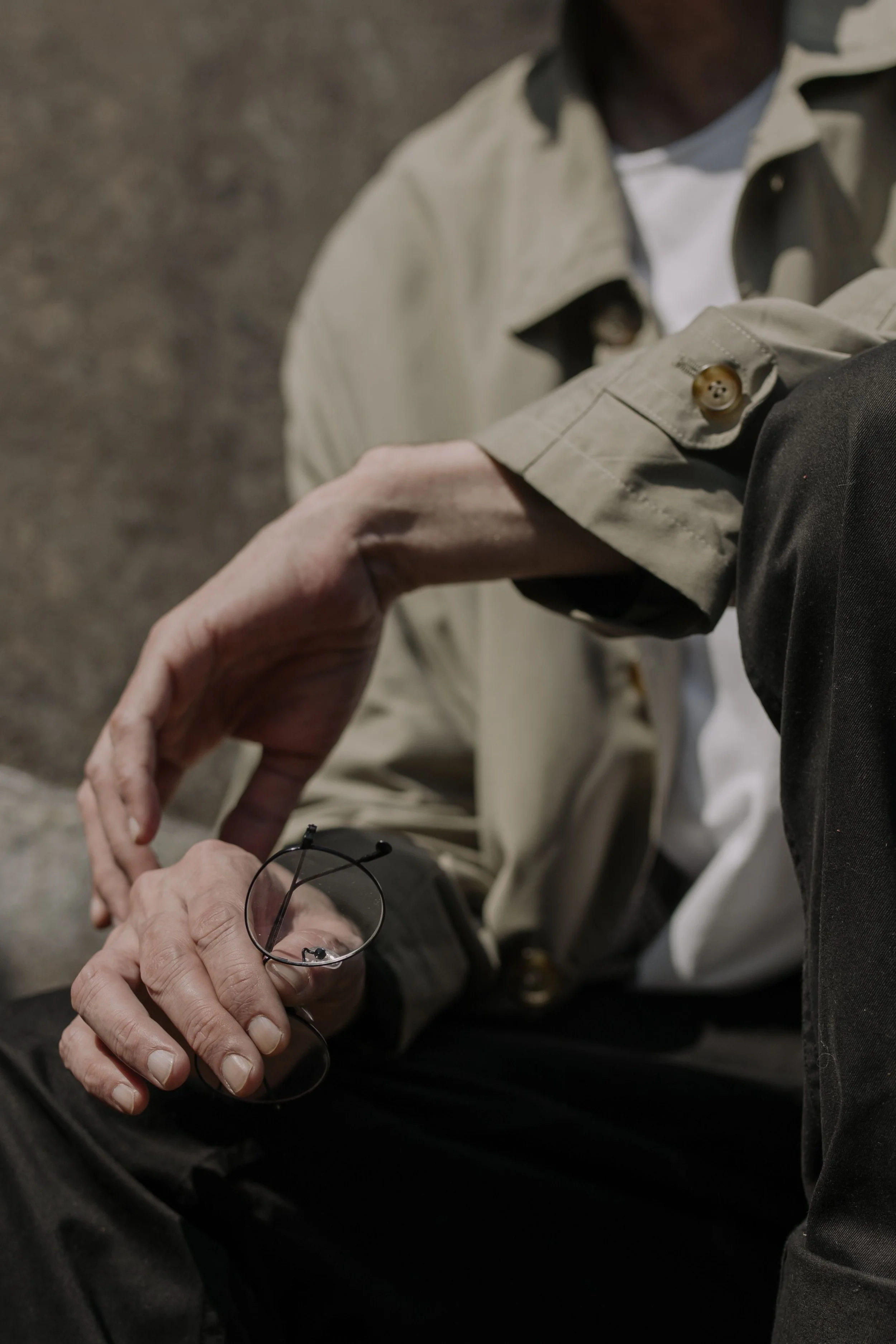
The firefighter who's been in the job fifteen years and doesn't talk about what he's seen. The ER nurse who started drinking more after COVID and can't fully explain why. The Vietnam veteran who came home to nothing — no acknowledgment, no support, no one who wanted to hear what it was actually like — and has been carrying 1968 in his body ever since. The Gulf War vet. The Marine back from Fallujah. The soldier who did three tours in Afghanistan and feels more danger at the grocery store than he ever wants to admit.

The 9/11 survivor who was in the building, or who ran toward it, or who watched it from a rooftop in Brooklyn and has never felt entirely safe since. Perhaps you lost someone that day and you still feel haunted by it all.

The person who was abused by a priest, a pastor, a coach, a teacher — someone trusted — and then watched the institution protect itself while they were left to figure out alone what to do with what happened. The shame in that particular wound is layered. You were harmed by someone who was supposed to embody safety. Then you were made to feel like the problem. That is its own kind of trauma, and it deserves to be named as such.

The physician who has pronounced more deaths than she can count and was never once asked how she was doing.
What connects all of these is not the story. It's what the body is still holding.
THE APPROACH
Working with the Nervous System
One of the things that sets PTSD apart is how deeply it's encoded in the body. The tightening in the chest before a difficult conversation. The way a sound or a smell can take you somewhere you thought you'd left. The activation that arrives even when your mind knows you're safe.
Talking about what happened can be useful. But for many trauma survivors — especially those who've been in insight-based therapy for years — narrating the experience activates the same nervous system response as the original event. The brain floods. The body braces. The understanding doesn't become relief.
Somatic Experiencing works where trauma actually lives: in the nervous system, in the body, in the responses that got interrupted or frozen at the moment of the original event. I've held the SEP credential since 2007, through Somatic Experiencing International.
SE does not require you to retell your story in detail. It tracks what's happening in your body right now — the sensations, the bracing, the activation, the shutdown — and gently guides the nervous system through what it never got to complete.
SE tends to be especially helpful for people who:
Have spent years in therapy, understand their patterns intellectually, and still can't shift them
Carry significant physical symptoms alongside the emotional ones
Feel disconnected from their bodies or have difficulty feeling safe in their own physical experience
Have early or developmental trauma that predates language
Find that memory-based approaches leave them more activated, not less
I draw on SE alongside CBT, psychodynamic work, and parts-based approaches. What serves your nervous system at this particular time is what we use.
"Twenty years in, what I know is this: the story matters, and the body has been trying to tell a version of it the whole time. When those two things finally meet, that's when something shifts."
The Process
What to Expect in PTSD Therapy
The first session is a conversation. Not an interrogation of your history. We talk about what brings you here, what you've tried, and what you need. There is no pressure to share more than feels right.
Building safety is not a preliminary step before the real work begins. It is the work.
From there, sessions unfold at a pace that matches your nervous system's capacity. Progress in trauma therapy rarely looks linear. You may feel lighter after some sessions and more stirred up after others. That is part of the process, not a sign something is wrong.
Sessions are 50 minutes. I offer a free 15-minute consultation so you can share what you're looking for and see if my approach resonates.
01 | Tracking body sensations
We learn to notice what trauma actually feels like in your body — without amplifying it or suppressing it. Awareness before action.
02 | Titration
We work with small, manageable pieces of what's difficult rather than flooding your system. Healing happens in increments the nervous system can tolerate.
03 | Pendulation
We move between activation and settling so your nervous system learns it can return to calm. The capacity to regulate expands from here.
04 | Completing interrupted responses
Completing interrupted responses We help your body finish the stress cycles that froze in place during the original event. This is where real discharge happens.
05 | Building resilience
Building resilience We gradually expand your window of tolerance so more of life feels manageable and safe. Healing is not the absence of difficulty. It's having more room to meet it.
What Becomes Possible on the Other Side
There is something that happens in trauma work that doesn't get talked about enough. Not just the reduction of symptoms. Not just feeling less bad. Something that looks, over time, like genuine transformation.
Researchers call it post-traumatic growth. I've watched it happen across twenty years with people who came in certain they were beyond repair.
It doesn't mean the trauma didn't happen. It doesn't mean what you went through was okay, or that you'd choose it. It means that the process of surviving something that hard — and then actually healing from it, rather than just managing it — can open something in a person that nothing else does.
People describe it differently. A clarity about what actually matters. Relationships that feel more real than they did before. A relationship with their own body they never had. A sense of purpose that emerged directly from the wound. The veteran who becomes the person other veterans finally talk to. The nurse who finds she can be present with patients in a way she couldn't access before. The survivor of religious abuse who builds a spiritual life that actually belongs to her.
Post-traumatic growth is not guaranteed. It is not a stage you pass through automatically if you do the work. But it is real. It is more common than the clinical literature used to acknowledge. And in my experience, it becomes available when the nervous system finally gets to put down what it's been carrying.
You came in to feel better. That's enough. But better is sometimes just the beginning of what's possible.
POST-TRAUMATIC GROWTH


C-PTSD: When Trauma Is Chronic or Developmental
Complex PTSD develops from prolonged, repeated, or relational trauma — the kind that happened inside relationships where escape was limited or impossible. Childhood neglect. Domestic violence. Emotional unavailability. Environments where love was conditional or safety was unpredictable. Religious or institutional abuse that went on for years, often hidden, often without anyone who believed you.
This is the territory where a single-incident model doesn't capture the full picture.
Beyond the core PTSD symptoms, C-PTSD often brings:
Profound difficulty with emotion regulation
Deep shame, self-blame, or a sense of being fundamentally broken
Disruptions in relationships and attachment
Difficulty maintaining a stable sense of who you are
C-PTSD is not a separate DSM-5 diagnosis, but it is recognized in the ICD-11 and increasingly in clinical practice. Treatment typically requires a longer timeline and a relational, phase-based approach that prioritizes safety and stabilization before deeper processing. Complex trauma is the primary focus of this practice.
If your history is complex, early, or relational, a somatic and relationally attuned approach is almost always more effective than protocol-only work.
PTSD Therapy in Palm Beach Gardens and Virtually Throughout Florida and Connecticut
I offer in-person sessions in Palm Beach Gardens and secure telehealth throughout Florida and Connecticut. Online therapy for PTSD is effective. The therapeutic relationship, the attunement, the safety — all of it translates to a virtual format.
This matters particularly for people whose trauma-related avoidance makes leaving home difficult, and for people outside major metro areas who haven't been able to access trauma-specialized care. For some veterans and first responders, telehealth also removes a barrier that has nothing to do with logistics: it's just easier to start when you don't have to walk into an office.
Limited in-person: Palm Beach Gardens, Florida
Telehealth: Throughout Florida and Connecticut
Sessions: 50 minutes, paced to your nervous system
Free consultation: 15 minutes to see if the fit is right

Get Started
You Don't Have to Keep Carrying This
Whatever you've been through, and however long you've been carrying it, healing is possible. I've seen this across twenty years with people whose trauma was fresh and people whose trauma was decades old. The nervous system has a genuine capacity to heal. You deserve support that actually meets where you are.
COMMON QUESTIONS
Frequently Asked Questions About PTSD Therapy
-
The approaches with the strongest evidence engage with traumatic material directly rather than working around it. Cognitive Processing Therapy, Prolonged Exposure, and Somatic Experiencing all fall into this category. Which fits depends on your history, your nervous system, and what has or hasn't worked before. A trauma-specialized therapist can help you figure that out. A free consultation is the right place to start.
-
It depends significantly on the nature and complexity of the trauma. Many clients notice meaningful shifts within twelve to sixteen sessions. Complex or developmental trauma — especially when it's early and relational — typically takes longer. Progress is rarely linear, and sessions are always paced to what your nervous system can manage.
-
Yes. Trauma-focused therapy is effective for many clients without medication. SSRIs and SNRIs are FDA-approved for PTSD and can be helpful, particularly when depression or anxiety are also present. That's a conversation between you and a prescribing physician — not a prerequisite for starting therapy.
-
Somatic Experiencing is a body-centered trauma therapy developed by Dr. Peter Levine. Rather than asking you to analyze or narrate what happened, SE tracks the physiological responses that became frozen in your nervous system after trauma — the bracing, the shutdown, the activation that doesn't quiet. By working with those responses directly, at a pace your nervous system can manage, the stored survival energy can discharge and complete. No detailed retelling required.
-
A lot of trauma-trained people end up in insight-based therapy that builds understanding without touching what the body is still holding. If you've done years of work and still feel stuck — if you understand your patterns and can't shift them — that's often a sign the nervous system hasn't been part of the conversation. SE works at that level. It's a genuinely different entry point, and for people who've tried everything else, it often moves things that nothing else could.
-
Yes. I've worked with veterans from Vietnam, the Gulf War, Iraq, and Afghanistan. Military trauma carries its own culture — the expectation that you handle it, the reluctance to be seen as struggling, the sense that asking for help means something about your strength. None of that is true, and none of it is a requirement here. You don't have to perform toughness in this room.
-
Yes. Firefighters, paramedics, law enforcement, ER nurses, physicians, and others who absorb trauma as part of the job — and who are often the last people to acknowledge that what they're carrying has a cost. The culture that makes you good at the work is often the same culture that makes it hard to seek help. I understand that. And I've seen what happens when people who've spent careers holding others finally get to put something down.
-
Sessions are provided on an out-of-network basis, and a superbill is available for potential reimbursement. Coverage depends on your plan's out-of-network mental health benefits. Contact your insurance provider before your first session to understand what may be available.
-
PTSD typically develops from a specific event or a bounded period of trauma. Complex PTSD develops from prolonged, repeated, or relational trauma — childhood neglect or abuse, domestic violence, religious or institutional abuse, years in an unsafe environment. Beyond the core PTSD symptoms, C-PTSD brings additional challenges with emotional regulation, self-perception, shame, and relationships. Both are treatable. Complex trauma is actually the primary focus of this practice.
-
A formal diagnosis requires evaluation by a licensed clinician. Common signs include intrusive memories or flashbacks, avoiding anything connected to the experience, emotional numbness or disconnection, difficulty sleeping, and a persistent sense of hypervigilance or danger. If something happened and life has felt different since — even if you've never named it, even if it was a long time ago — speaking with a trauma-specialized therapist is the right first step.
-
Someone licensed in your state with specific training in trauma-focused approaches. Advanced credentials like the SEP designation indicate specialized body-based trauma training beyond general licensure. And trust your instincts about the fit. Trauma therapy depends on feeling genuinely safe with your therapist. Most offer a free consultation for exactly that reason.
Jennifer Goggin, LPC, LMHC, SEP, is a licensed psychotherapist and Somatic Experiencing Practitioner in Palm Beach Gardens, Florida with over 20 years of clinical experience specializing in PTSD and complex trauma. She has held the SEP credential since 2007 and works at the level of the nervous system, helping clients move through the survival responses that became frozen after overwhelming experience, without requiring detailed narrative retelling. Her practice draws on Somatic Experiencing, CBT, and attachment-focused therapy, with a particular focus on C-PTSD and developmental trauma. Jennifer offers in-person sessions in Palm Beach Gardens, Florida and secure telehealth throughout Florida and Connecticut.